Wuthering Heights: the order of telling against the order of time
Published
How Emily Brontë tells the earlier years after 1801
The first word of the book is a year, 1801, in Lockwood's diary. Chapter 4 then goes back to the summer when Heathcliff is brought to the house. The year is not printed in the chapter; C. P. Sanger, in 1926, reckons it as 1771. Chapter 7 reaches the summer of 1778, a date printed in the text.
Chapter 32 opens on a year too: 1802. The years printed in the book are 1801, 1778 and 1802; 1771 is not printed but reckoned by Sanger from the text. Drawn as one bar per chapter, each bar to the chapter's words counted from its heading to the next in the Project Gutenberg text, with the printed years marked over the bars and 1771 marked as Sanger's, the line of years does not follow the line of chapters: it starts at 1801, drops at chapter 4 to 1771, and reaches 1802 at chapter 32. Chapters 1 to 3 hold 9% of the words.
Counted chapter by chapter in the Project Gutenberg text, a chapter counting when the name appears in it at least once, Isabella is named in 14 of the 34 chapters: 6, 7, 8, 10, 11, 12, 13, 14, 16, 17, 19, 21, 22 and 23, none before chapter 6 and none after chapter 23.
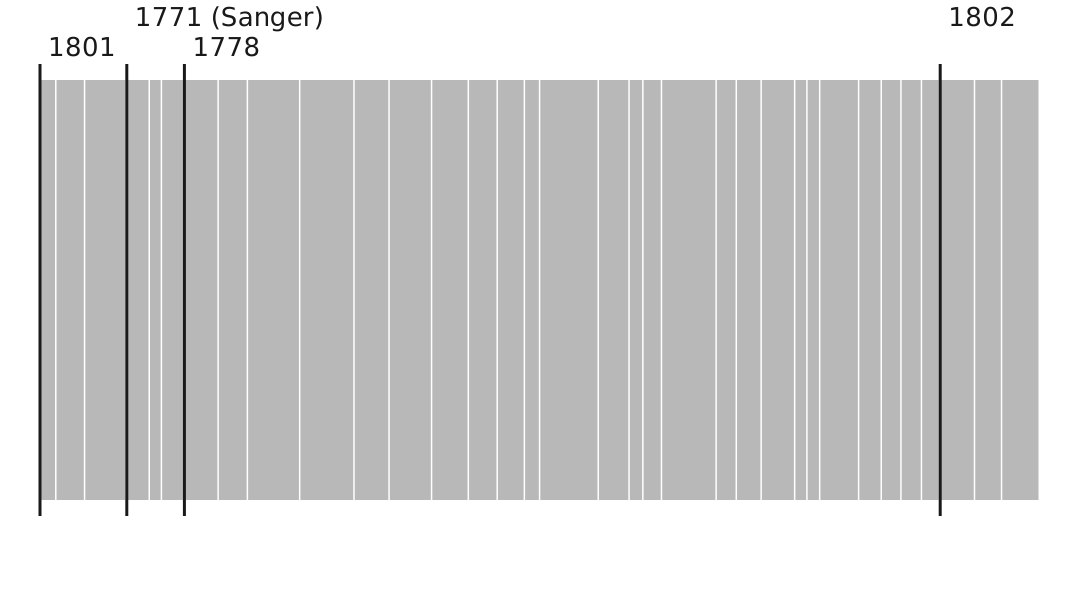
Illustration drawn from the chapter lengths, in words, that Scrin's import measures in the Project Gutenberg text, a chapter's length being its words from its heading to the next; the printed years 1801, 1778 and 1802 marked over the bars, and 1771, the year of chapter 4 as C. P. Sanger reckons it (1926), marked apart. Not a Scrin screen.
What it offers someone writing now
A novel can tell its story in an order other than the one it happened in. Sanger, in 1926, showed that a reader can rebuild the years from inside the text. Written beside each chapter of a manuscript, in the order told, the year it happens in shows where the telling leaves the order of time, and for how long.
The analysis behind it
C. P. Sanger rebuilt the novel's chronology from internal evidence in “The Structure of Wuthering Heights” (Hogarth Essays, 1926): “the first word in the book was a date—1801”; “Similarly, the first word of Chapter XXXII is 1802. Apart from this, only one other date is given directly.” https://wuthering-heights.co.uk/sanger
The text: Project Gutenberg #768.
See your own manuscript this way
Scrin is a home where pages grow into books: you keep writing, from an untitled line to a chapter, and Scrin keeps the rest.
Import a manuscript and Scrin gives it back as a book you can read differently: its plan, the length of every chapter, and what keeps coming back.