A Tale of Two Cities: two men alike, from the London trial to the last chapter
Published
Carton and Darnay: two men alike enough to be taken for each other
The book has 45 chapters in three books, each numbered from chapter I again: Book the First, Recalled to Life, 6 chapters, 17,369 words, 13% of the book; Book the Second, the Golden Thread, 24 chapters, 70,439 words, 52%; Book the Third, the Track of a Storm, 15 chapters, 48,263 words, 35%. It is 136,320 words.
At the London trial, in chapter 3 of Book the Second, Stryver, Darnay's counsel, has a witness look at his colleague Sydney Carton and then at the prisoner: “Are they very like each other?” With Carton's wig off, “the likeness became much more remarkable”, and the witness's evidence falls apart. In chapter 2, Carton is already in court, unnamed: “another wigged gentleman”.
Counting a chapter when the name is printed in it at least once, Darnay is named in 19 chapters, from chapter 2 of Book the Second to chapter 13 of Book the Third; Carton in 15, from chapter 3 of Book the Second to the last chapter; both in 10.
Drawn as one bar per chapter, with one row each for Carton, Darnay and Stryver, Darnay's row and Carton's row both begin at the London trial, one chapter apart, and run side by side to chapter 13 of Book the Third; there Darnay's row stops, and Carton's goes on alone to the last chapter.
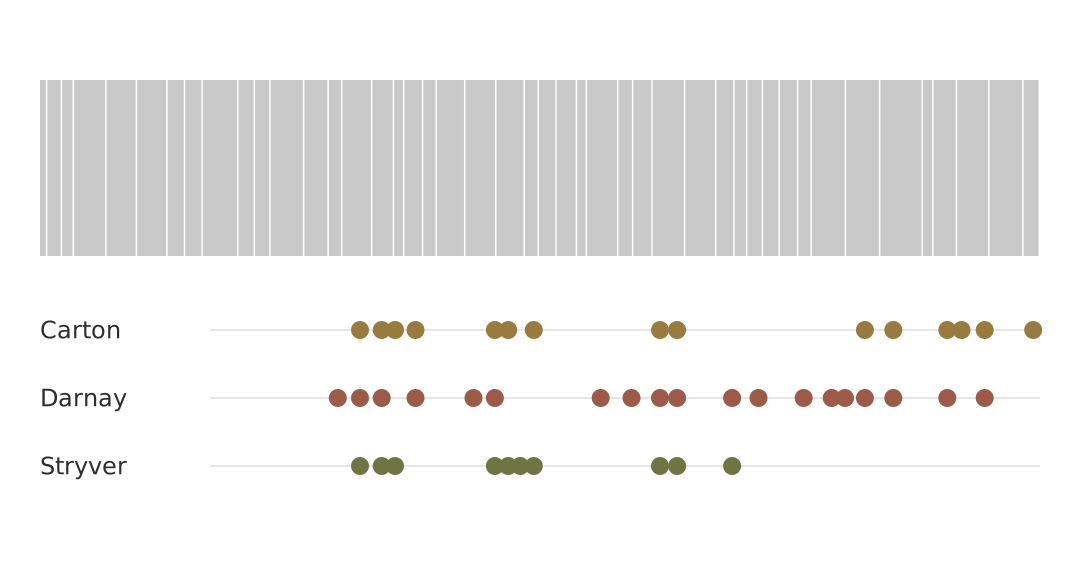
Illustration drawn from the chapter lengths, in words, counted for this page, October 2026, in Project Gutenberg #98, a chapter's length being its words from its heading to the next; the chapters where Carton, Darnay and Stryver are named, found the same way; the doubling after Joel J. Brattin (2012).
What it offers someone writing now
Two characters can be built to be taken for each other, and a plot can turn on the likeness more than once. Brattin (2012) calls the novel “almost obsessed with doubles and doubling” and writes that the likeness of Carton and Darnay gets Darnay “released from mortal jeopardy in each of the two cities”. Give each of a manuscript's paired characters a row, mark every chapter that names them, and read where the rows meet: the chapters that name both are where a likeness can be used.
The analysis behind it
Joel J. Brattin, “Sydney Carton's Other Doubles”, Cahiers victoriens et édouardiens, special issue Dickens in the New Millennium (2012): “A Tale of Two Cities (1859) is a novel almost obsessed with doubles and doubling.” https://journals.openedition.org/cve/12398
How it was counted: by Scrin, in October 2026, in the Project Gutenberg plain-text edition, #98, from the ebook's start marker to its end marker, so everything before the first chapter is included, 249 words; a chapter's length runs from its heading to the next heading; a word is a segment that Unicode word segmentation (UAX #29) marks as word-like, except that a hyphen between two letters or digits does not split it, so a hyphenated word counts once.
The text: Project Gutenberg #98.
See your own manuscript this way
Scrin is a home where pages grow into books: you keep writing, from an untitled line to a chapter, and Scrin keeps the rest.
Import a manuscript and Scrin gives it back as a book you can read differently: its plan, the length of every chapter, and what keeps coming back.