The Scarlet Letter: the scaffold at the beginning, the middle and the end
Published
Where the scaffold stands in The Scarlet Letter
F. O. Matthiessen (1941) finds the novel's design built around three scenes on the scaffold of the pillory: Hester's public shaming at the opening, the minister's midnight vigil midway, his confession at the end. They fall in chapter 2, The Market-Place, chapter 12, The Minister's Vigil, and chapter 23, The Revelation of the Scarlet Letter. The book is 83,707 words, and 15,084 of them, 18%, come before chapter I: the title, the contents and The Custom-House, Hawthorne's introduction. Its chapters run from 487 words, chapter 1, to 3,850, chapter 20.
Searched in the plain text chapter by chapter, capitals ignored, the word scaffold occurs 30 times, all in 7 chapters: 7 times in chapter 2 and 4 in chapter 3, 7 in chapter 12, then 1 in chapter 21, 2 in 22, 7 in 23 and 2 in 24; the 17 other chapters never print it.
Counted from chapter I on, The Custom-House left before it, chapter 12 runs from 46% to 51% of the tale's 68,623 words, so the middle of the tale falls inside the vigil; chapter 2 runs from 1% to 6%, chapter 23 from 92% to 97%.
Counting a chapter when the name is printed in it at least once, Governor Bellingham and the Reverend Mr. Wilson, both named in chapter 3, are named again in chapters 12 and 23.
Drawn as one bar per chapter, the chapters that print scaffold marked, with one row each for Bellingham and Wilson, the marks gather at the opening, the centre and the close.
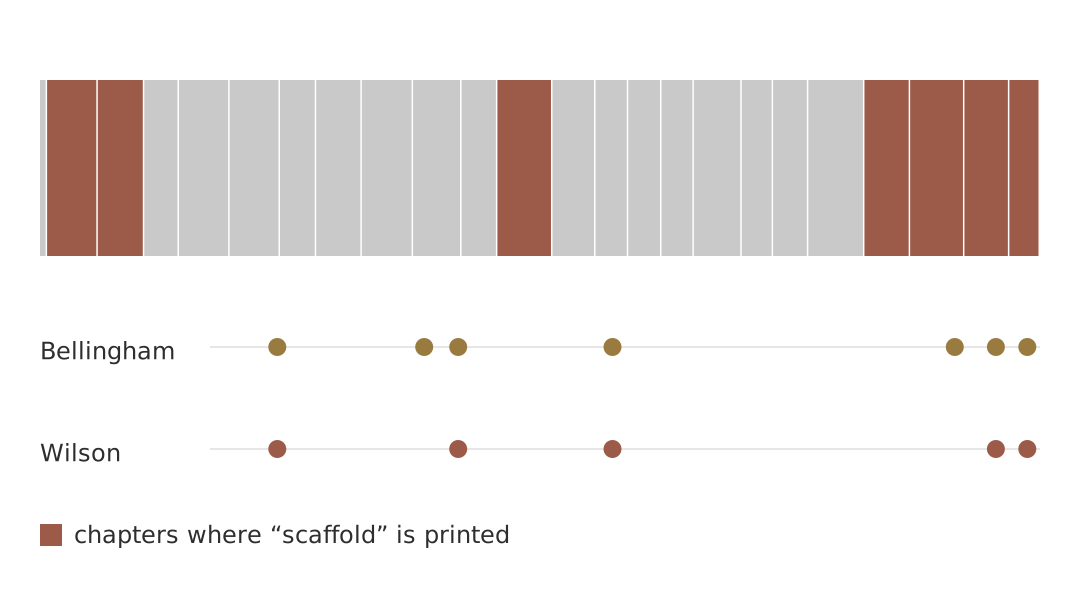
Illustration drawn from the chapter lengths, in words, counted for this page, October 2026, in Project Gutenberg #33, a chapter's length being its words from its heading to the next, The Custom-House left before chapter I and not drawn; the chapters that print the word scaffold, and the chapters where Bellingham and Wilson are named, found the same way; the three scaffold scenes after F. O. Matthiessen (1941).
What it offers someone writing now
A novel can return to one place at its beginning, its middle and its end, and let that place carry its turns. Matthiessen (1941) writes that the book's “symmetrical design is built around the three scenes on the scaffold”. Name the place a manuscript returns to, search each chapter for it, and set each chapter that names it against the share of the words that come before it: whether the returns land at the opening, the centre and the close is then measured, not guessed.
The analysis behind it
F. O. Matthiessen, American Renaissance: Art and Expression in the Age of Emerson and Whitman (Oxford University Press, 1941), on The Scarlet Letter: “Its symmetrical design is built around the three scenes on the scaffold of the pillory.” Read in the scan of the 1941 edition held by the Digital Library of India, on the Internet Archive. https://archive.org/stream/in.ernet.dli.2015.499333/2015.499333.american-renaissance_djvu.txt
How it was counted: by Scrin, in October 2026, in the Project Gutenberg plain-text edition, #33, from the ebook's start marker to its end marker, so everything before chapter I is included; a chapter's length runs from its heading to the next heading; a word is a segment that Unicode word segmentation (UAX #29) marks as word-like, except that a hyphen between two letters or digits does not split it, so a hyphenated word counts once.
The text: Project Gutenberg #33.
See your own manuscript this way
Scrin is a home where pages grow into books: you keep writing, from an untitled line to a chapter, and Scrin keeps the rest.
Import a manuscript and Scrin gives it back as a book you can read differently: its plan, the length of every chapter, and what keeps coming back.