Pride and Prejudice: Darcy's letter as the hinge
Published
How Austen hinges a whole novel on a letter
Darcy's letter is in chapter 35 of 61. The chapter is 3,003 words, counted from its heading to the next in the Project Gutenberg text, and runs from 51% to 54% of the book, a position being the share of the book's words that come before it: just past the middle. It opens on Elizabeth's walk the next morning; Darcy hands her the letter, and the rest of the chapter, to its signature, is the letter, most of the chapter's words. In it Darcy answers the two charges Elizabeth made against him the evening before: his part in separating Bingley from Jane, and his dealings with Wickham.
Counted chapter by chapter in the Project Gutenberg text, a chapter counting when the name appears in it at least once, Darcy's name appears in 50 chapters, Wickham's in 34. Drawn as one bar per chapter, chapter 35 is marked as the letter's chapter: one bar, set apart, where the two charges are answered.
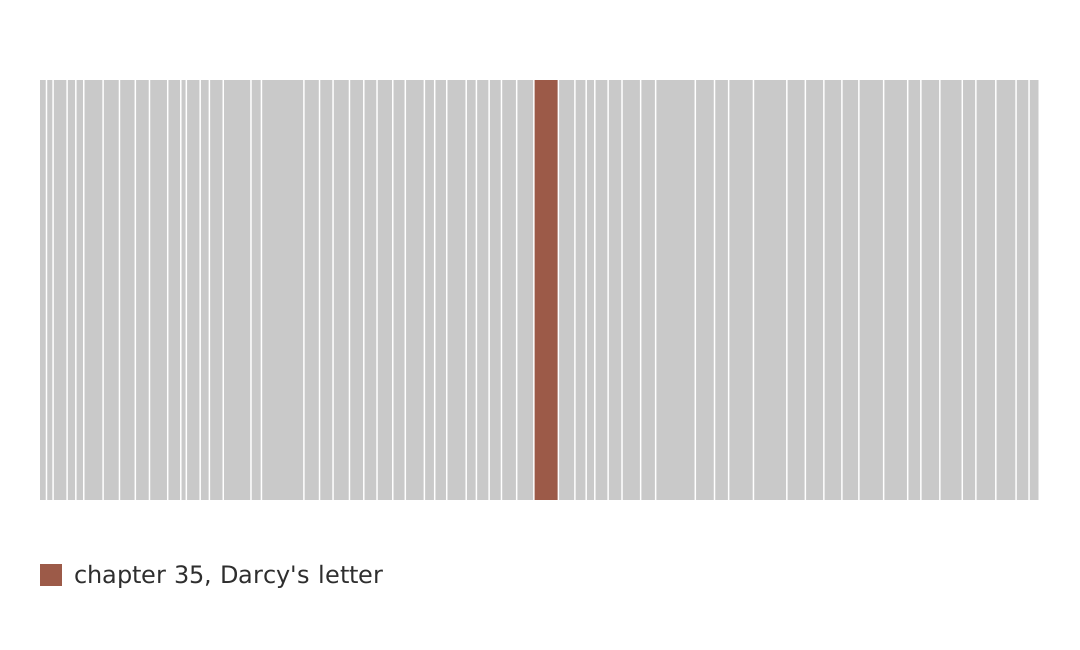
Illustration drawn from the chapter lengths, in words, that Scrin's import measures in the Project Gutenberg text; chapter 35 marked as the letter after Elisabeth Lenckos (2005). Not a Scrin screen.
What it offers someone writing now
A novel written in scenes and conversation can still turn on a document one character hands to another. Lenckos notes that the book rejects the epistolary tradition and yet hinges on a letter. Mark the chapter where a manuscript turns and read off its place in the whole: how far in it comes, and how much of the book it takes.
The analysis behind it
Elisabeth Lenckos, Persuasions On-Line 26:1 (JASNA, 2005): the novel rejects the epistolary tradition, yet “its turning point hinges on a letter”. https://jasna.org/persuasions/on-line/vol26no1/lenckos.htm
The text: Project Gutenberg #1342.
See your own manuscript this way
Scrin is a home where pages grow into books: you keep writing, from an untitled line to a chapter, and Scrin keeps the rest.
Import a manuscript and Scrin gives it back as a book you can read differently: its plan, the length of every chapter, and what keeps coming back.