Moby-Dick: the story stops for whales
Published
How Melville stops the story for whales
Of 135 chapters, 30 name none of these 11: Ahab, Ishmael, Queequeg, Starbuck, Stubb, Flask, Tashtego, Daggoo, Fedallah, and the owners Peleg and Bildad; a chapter counts when none of the 11 appears in it once. The count was made by Scrin for this page in October 2026, in the Project Gutenberg plain-text edition, #2701, from the ebook's start marker to its end marker, so the title page, contents, Etymology and Extracts, 4,350 words before chapter 1, and the Epilogue are included in the book's 213,684 words; a chapter's length runs from its heading to the next heading; a word is a word as Unicode word segmentation counts it, a run of letters or digits, a hyphenated word counting once. The 30 chapters are 8, 9, 14, 23, 25, 32, 45, 56, 57, 58, 60, 62, 63, 68, 69, 75, 76, 77, 80, 82, 83, 85, 86, 88, 89, 90, 97, 98, 103 and 105, and by the same count they hold 18% of the book's words. Chapter 32, “Cetology”, is 5,131 words of classification.
Ahab is named in 70 chapters, by the same count, a chapter counting when the name appears in it at least once. Drawn as one bar per chapter, with the 30 chapters that name none of the 11 set apart from the rest, the book shows its two kinds of chapter side by side.
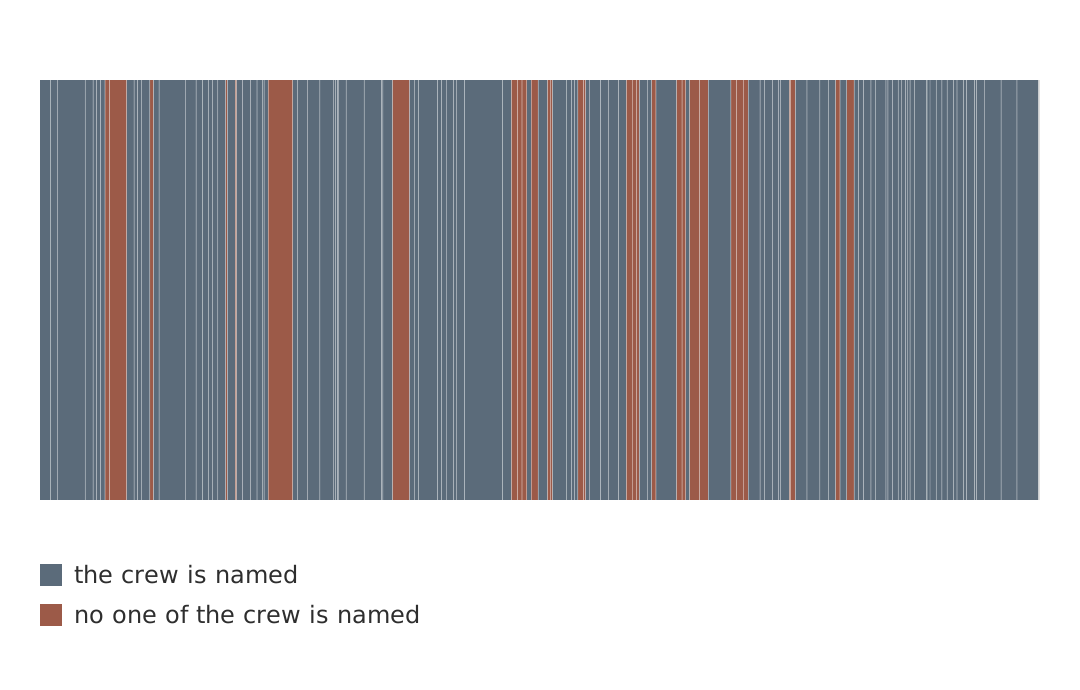
Illustration drawn from the chapter lengths, in words, counted for this page, October 2026, in Project Gutenberg #2701, a chapter's length being its words from its heading to the next; the 30 chapters that name none of the 11 set apart from the rest, a split counted for this page, October 2026; Chelsea Miya (DH2018) is cited for the cetology chapters, not for the split. Not a Scrin screen.
What it offers someone writing now
Miya writes that the cetology chapters, “interwoven into the mid-section of the novel”, are “curiously devoid of characters or plot development”, and argues from how the chapters cluster by style that the novel has “two unique stylistic signatures”. A writer can mark the chapters of a manuscript where none of its people appear and read how long each stretch runs: where a book leaves its characters, and for how long, is then a shape to keep on purpose or to cut.
The analysis behind it
Chelsea Miya (University of Alberta), “The Two Moby Dicks: The Split Signatures of Melville's Novel” (DH2018): the cetology chapters are “curiously devoid of characters or plot development”; the novel has “two unique stylistic signatures”. https://dh2018.adho.org/en/the-two-moby-dicks-the-split-signatures-of-melvilles-novel/
The text: Project Gutenberg #2701.
See your own manuscript this way
Scrin is a home where pages grow into books: you keep writing, from an untitled line to a chapter, and Scrin keeps the rest.
Import a manuscript and Scrin gives it back as a book you can read differently: its plan, the length of every chapter, and what keeps coming back.