Great Expectations: a part a week, and where each one was cut
Published
59 chapters, 36 weekly parts: where every break fell
The novel has 59 chapters, first published in 36 weekly parts in All the Year Round, from 1 December 1860 to 3 August 1861. It is 185,373 words, counted by Scrin for this page in October 2026, in the Project Gutenberg plain-text edition, #1400, from the ebook's start marker to its end marker, so everything before chapter I is included, 128 words; a chapter's length runs from its heading to the next heading, from 780 words, chapter 6, to 5,738, chapter 19; a word is a segment that Unicode word segmentation (UAX #29) marks as word-like, except that a hyphen between two letters or digits does not split it, so a hyphenated word counts once. Most chapters, Smith College Libraries note in Charles Dickens at 200 (2012), end with a suspenseful event; that is their reading, and this page does not count it.
Chapter 17 closed the part of 2 February 1861; chapter 18, where the lawyer arrives with the expectations of the title, opened the next, a week later. By Allingham's table, the 36 parts ended after chapters 2, 4, 5, 7, 8, 10, 11, 13, 15, 17, 18, 19, 21, 22, 24, 26, 28, 29, 31, 33, 35, 37, 38, 39, 40, 42, 44, 46, 48, 50, 52, 53, 54, 56, 57 and 59. The table prints part 23 as chapters 36 and 37, like part 22, and places chapter 38 nowhere; the issue of All the Year Round for 4 May 1861, read in facsimile on Dickens Journals Online, opens at page 121 on chapter XXXVIII, the issue of 27 April 1861 carrying chapters XXXVI and XXXVII and that of 11 May 1861 opening on chapter XXXIX, so part 23 is chapter 38 alone, as the list gives it. Drawn as one bar per chapter, each to its length by the same count, with the end of each of the 36 parts marked, the breaks fall where the book was once cut.
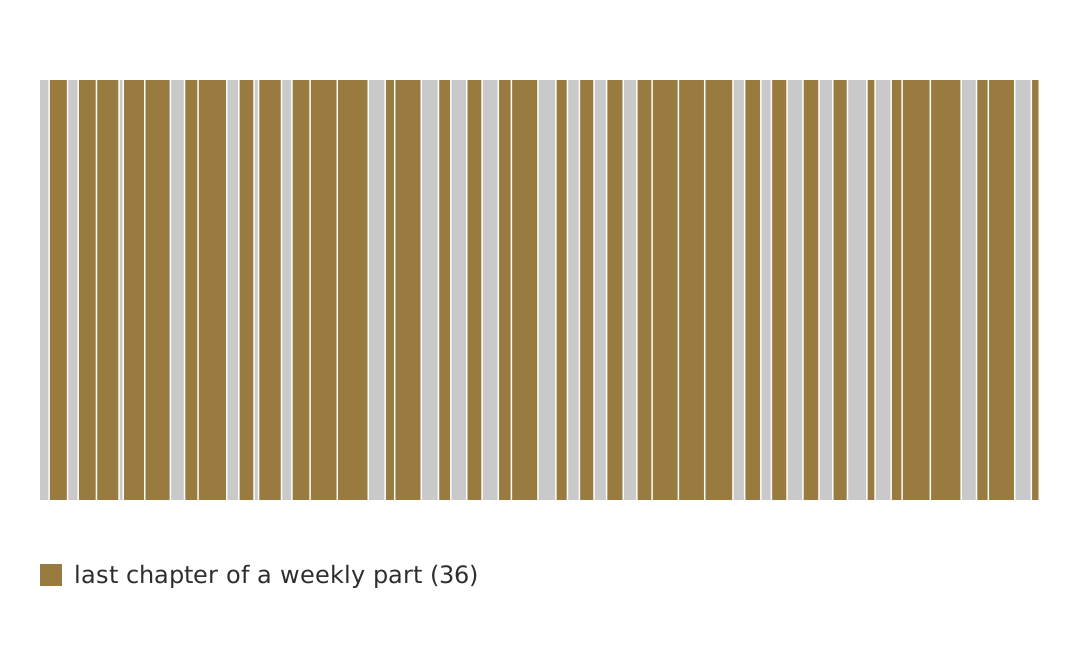
Illustration drawn from the chapter lengths, in words, counted for this page, October 2026, in Project Gutenberg #1400, a chapter's length being its words from its heading to the next; the end of each of the 36 parts after Philip V. Allingham (Victorian Web, 2004, following Fielding 1958 and Vann 1985), the end of part 23 after the issue of 4 May 1861 read on Dickens Journals Online. Not a Scrin screen.
What it offers someone writing now
A long book can be written to be read in pieces, each piece cut at a chapter's end. Smith College Libraries note, in a 2012 exhibition, that most chapters end with a suspenseful event; this page cites that reading and does not count it. Mark where a manuscript breaks, and read the last page before each break: whether it closes on an event or on a pause is then a choice made on purpose.
The analysis behind it
Smith College Libraries, Charles Dickens at 200 (Mortimer Rare Book Collection, Neilson Library, January to April 2012): “most chapters end with a suspenseful event”; part divisions after Philip V. Allingham, the Victorian Web (2004), following K. J. Fielding (1958) and J. Don Vann (1985); the issue of All the Year Round for 4 May 1861, opening on chapter XXXVIII, read in facsimile on Dickens Journals Online. https://victorianweb.org/authors/dickens/ge/geserialisation.html
The text: Project Gutenberg #1400.
See your own manuscript this way
Scrin is a home where pages grow into books: you keep writing, from an untitled line to a chapter, and Scrin keeps the rest.
Import a manuscript and Scrin gives it back as a book you can read differently: its plan, the length of every chapter, and what keeps coming back.